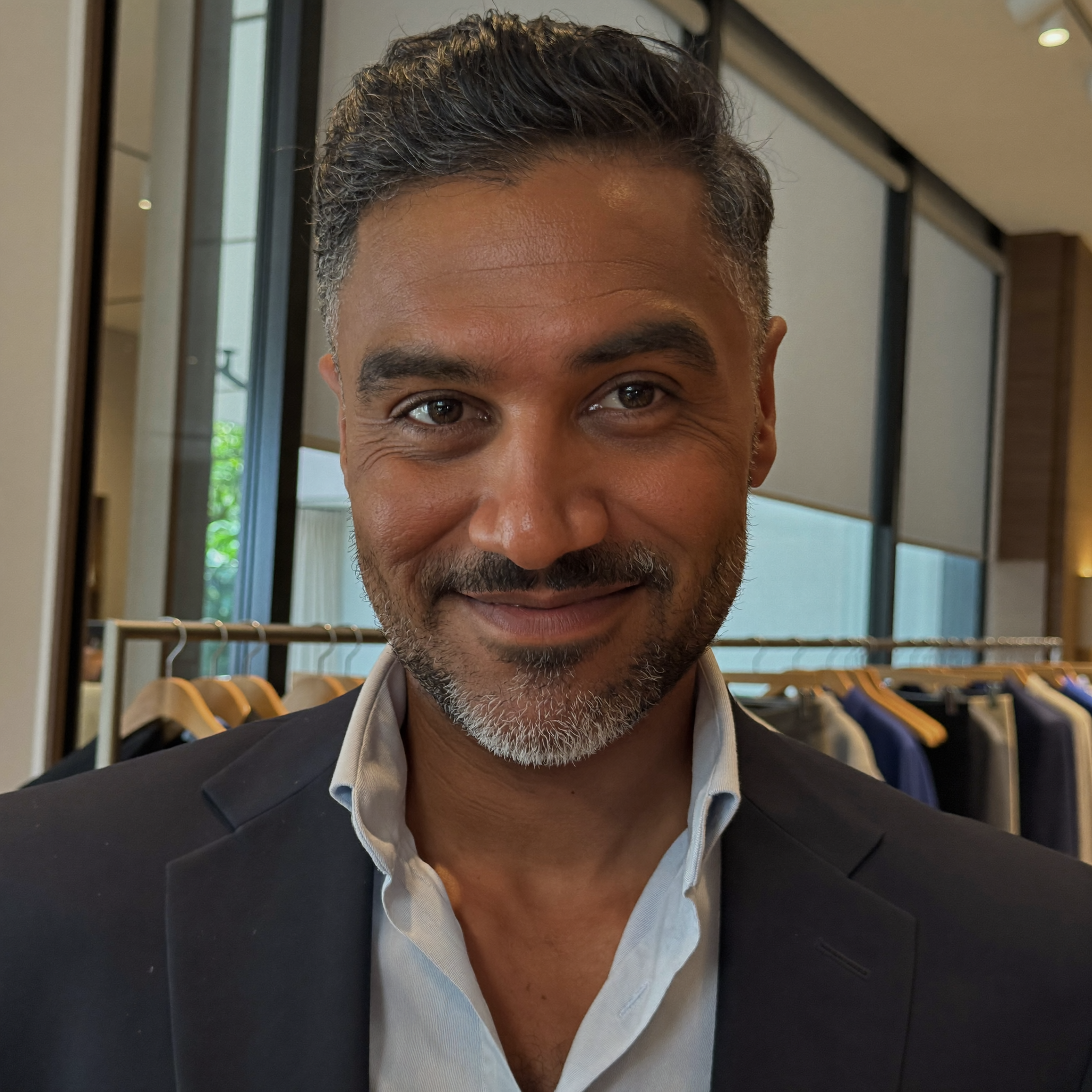
Riaz M.
Premium Fashion Retail
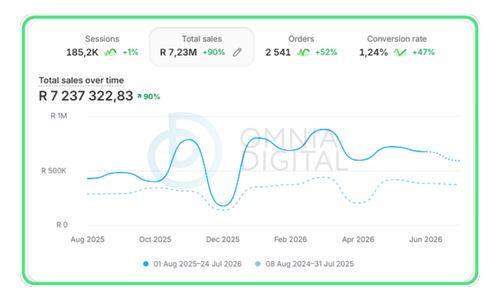
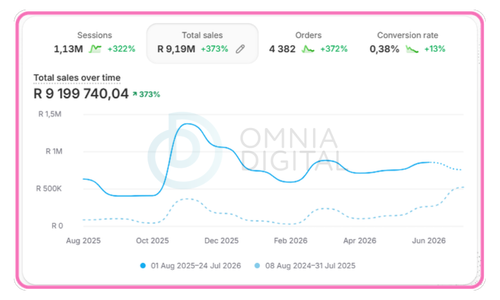
R4.9M → R13.3M
Online Revenue · May–Oct 2025 vs the 6 Months After
We build your ads, content and product pages, all tailored to your e-commerce business, so more sales come in without spending more on ads
Actual Client Results
Every business below had a bad advertising foundation, was working with a generalist agency, running ads themselves, or had a bad ecommerce website.
Premium Fashion Retail
R4.9M → R13.3M
Online Revenue · May–Oct 2025 vs the 6 Months After
Fragrance & Perfume
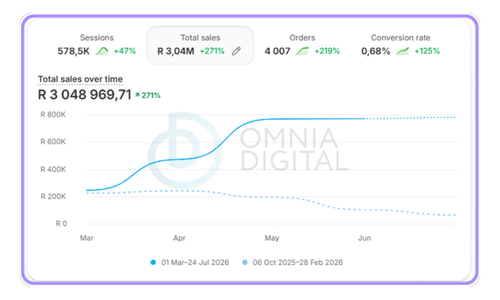
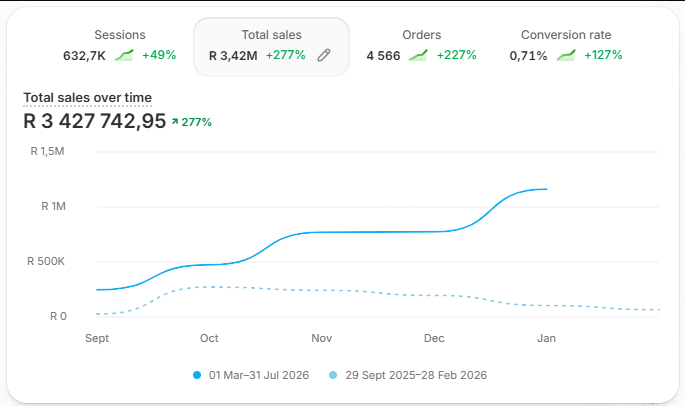
−41% → +277%
Revenue · 5 Months Before vs 5 Months After
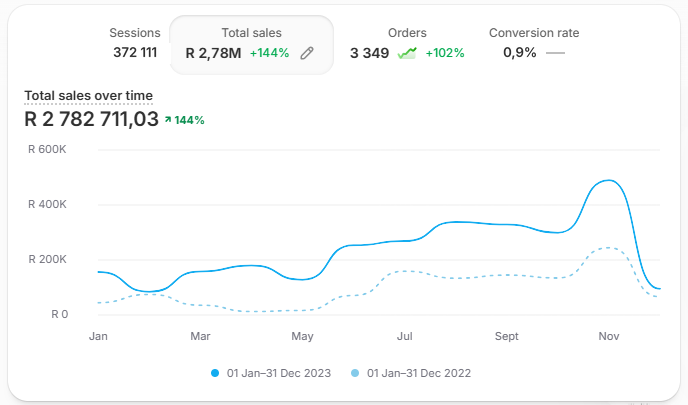
Online Plant Nursery
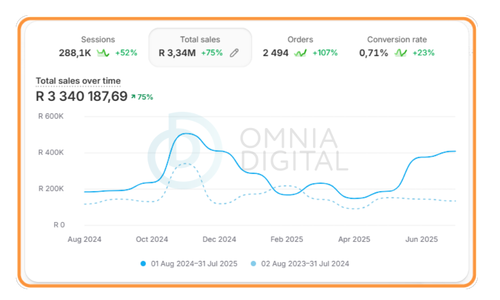
R2.8M → R6.6M
Revenue · +139% in One Year
Toys & Games
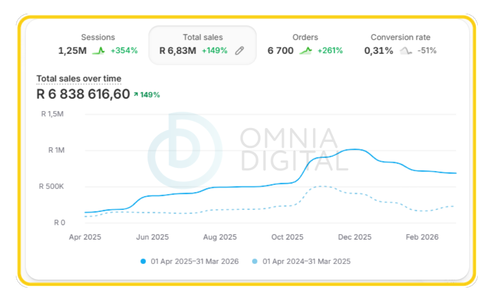
R2.8M → R7.2M
Online Revenue · +157% Year on Year
Footwear
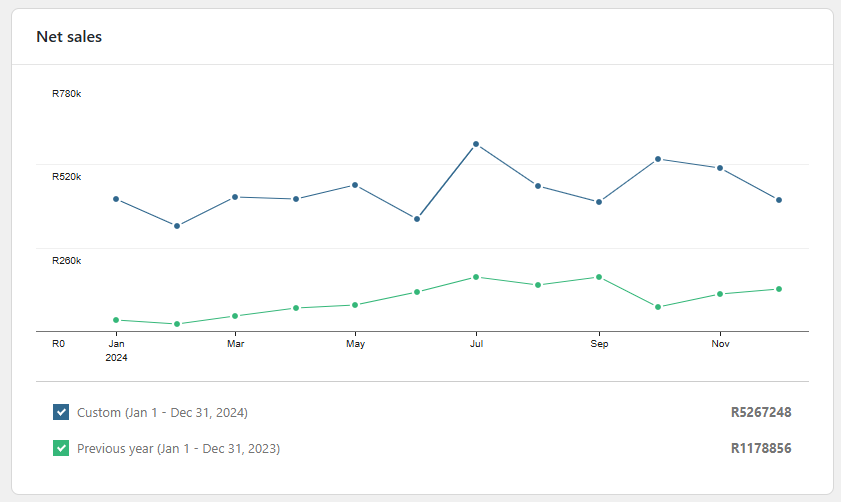
R1.2M → R5.3M
Revenue · +347% Year on Year
Baby & Maternity
+35% Profit
Profitability Growth · Same Ad Budget
Premium Fashion Retail
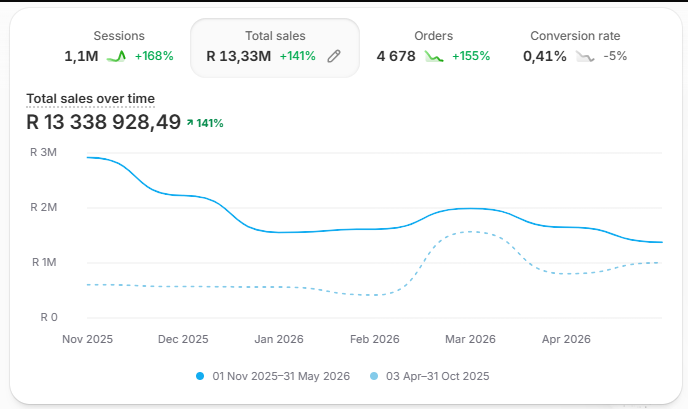
Comparing the 6 months before partnering (May–Oct 2025) with the period after launch (Nov 2025–May 2026)
A premium fashion retailer with an established footprint of physical stores and a catalogue spanning a wide range of well-known brand-name labels. The brand itself was strong and the stores were performing, but the online side of the business had never reached the same level.
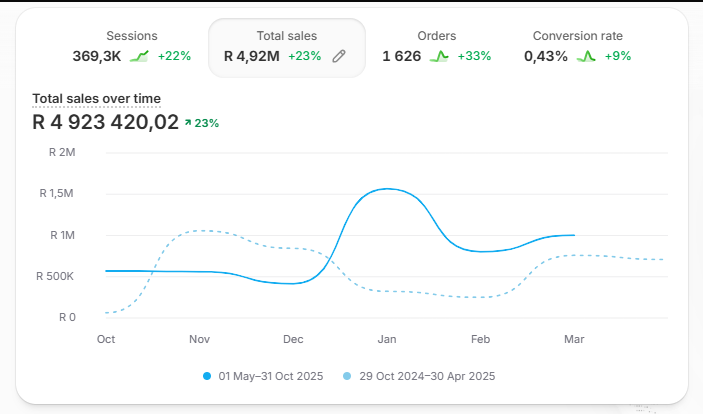
Marketing had been handled in-house, with a few agencies tried along the way. Results were up and down: moments of success, but never sustained. The team knew the store could do more. In the six months before partnering with us (May to October 2025), the online store did R4.9M in revenue.
Our audit found the reasons quickly: the conversion tracking foundations on both Meta and Google were incorrectly set up, campaign structure had almost no segmentation, a serious limitation for a store selling dozens of distinct brands, and the website itself had user-experience friction costing them conversions.
We started at the foundation and worked up. First, a conversion-rate pass on the website to fix the user-experience issues. Then a full rebuild of the conversion tracking across Meta and Google to the Omnia standard, so every decision from that point was based on accurate data.
From there we sat with the client to map out each brand in the catalogue: margins, stock position, what they wanted to push and what past data showed. That fed a full creative production run: AI-generated video and imagery, lifestyle shots, carousels and catalogue ads, all built for conversion. We launched brand-segmented campaigns across both Meta and Google, scaled Google hard, and layered in email marketing using the same brand segmentation with every flow rebuilt and tested.
Performance picked up from the day the new structure went live. From November 2025 to May 2026 the store did R13.3M, 141% up on the comparable prior period, with sessions up 168% and orders up 155%, all on effectively the same ad spend. Monthly revenue run rate climbed from roughly R820K to R1.9M.
The engagement has since shifted to pure scaling: monthly reporting and strategy sessions, stock-driven planning and clearance-sale support, and continual improvement brand by brand.
Baby & Maternity
Year 1 (flat ad spend, margin focus): +35% profit. Year 2 (TikTok added, +15% spend): scaled further. Compared against the final year with their previous agency.
A well-established online store in the baby and maternity space, selling a broad catalogue of products for expecting mothers, newborns and toddlers. The business had been trading for years and had a solid, loyal customer base by the time we started working together.
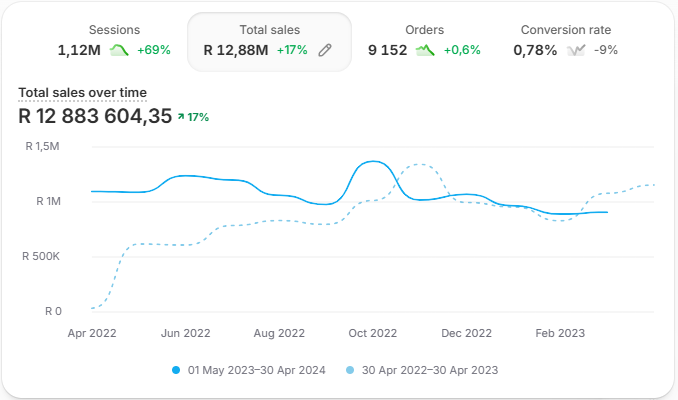
In the year before partnering with us (May 2023 to April 2024) the store was managed by another agency and did R12.9M in revenue. They had hit a ceiling. The previous agency could not scale the account any further, and although they kept adding budget, the extra spend only produced diminishing returns. Growth had stalled and more money was no longer the answer.
The strategy was also one-dimensional: chase top-line revenue, with little attention paid to which products were actually making money.
We started with the Omnia foundations: a full rebuild of conversion tracking and a large, ongoing content production run across image, video and carousel formats. But the strategic shift was where the real value came from.
In year one we deliberately kept ad spend constant and changed the focus from revenue to profit. Rather than pushing whatever sold easiest, we prioritised the higher-margin products, even the ones that were harder to sell, so that every rand of the same budget worked toward margin instead of just a bigger revenue number. The result was a 35% increase in profitability in our first year, without spending a cent more on ads.
A year in, with the foundations proven, we opened the taps: we introduced TikTok ads to reach a new audience and beat content fatigue with fresh formats, and increased ad spend by around 15% to scale the account further, this time with the creative breadth and horizontal structure to turn that budget into profitable growth rather than diminishing returns.
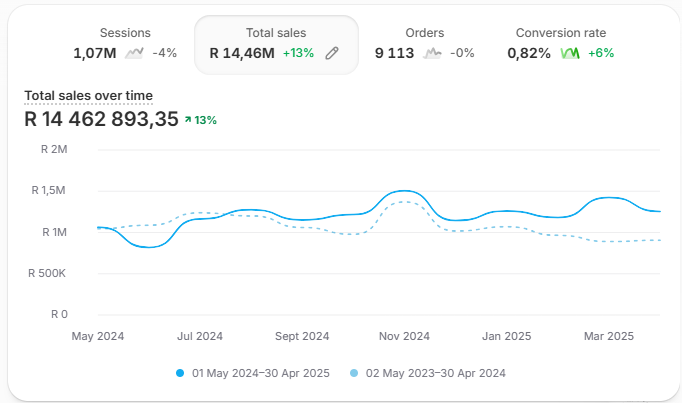
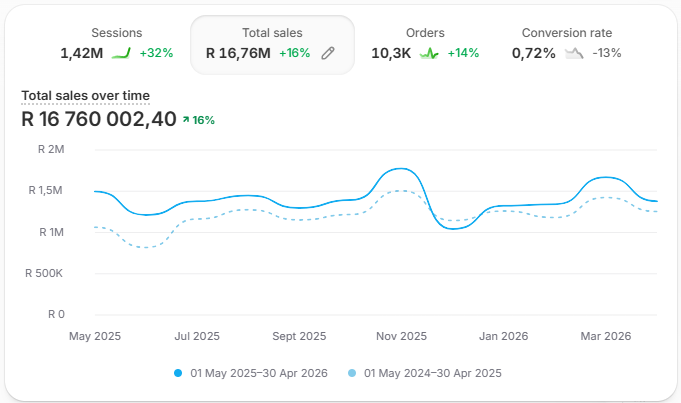
In our first year (May 2024 to April 2025) revenue grew to R14.5M, up roughly 15% on the prior year, on flat ad spend, while profitability jumped 35%. In year two (May 2025 to April 2026), with TikTok live and spend up around 15%, revenue climbed again to R16.8M and order volume rose 14%, taking total revenue growth to around 30% across the two years.
The headline is profitability: it has grown far faster than revenue and dramatically faster than ad spend. By breaking through the ceiling the previous agency could not, shifting the focus to margin, and scaling horizontally, we turned a stalled, mature store into one that grows its bottom line year on year.
Toys & Games
B2C store revenue, comparing the 12 months before scaling with Omnia (May 2024–Apr 2025) against the 12 months after (May 2025–Apr 2026)
An online toy retailer with a wide catalogue spanning every kind of toy, plus a substantial B2B wholesale arm that we also manage. This case study focuses purely on the B2C side of the business: the direct-to-consumer online store.
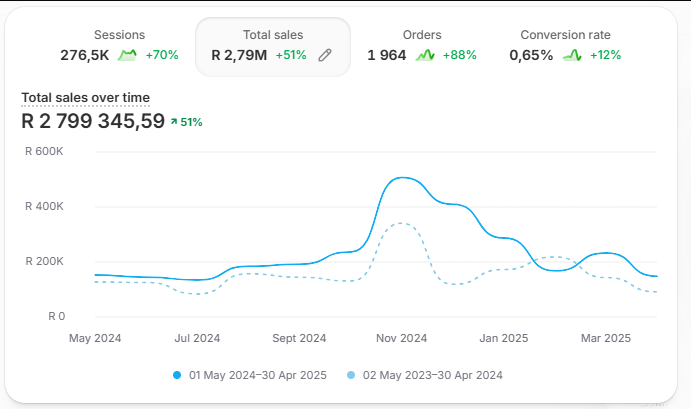
Before working with us the store was small and struggling to break the R200k per month mark. They had seen varying levels of success over time but could never find a way to scale consistently. The growth ceiling was low and stubborn.
We took over the full paid strategy and built it around a combination of Meta and Google paid ads, supported by social media and email marketing. The biggest lever was granular product segmentation paired with Google's intent-based reach.
On Google we broke every product line out into its own asset group within Performance Max, and ran standard Shopping, Search, and PMax campaigns alongside each other, with dedicated focus on each of the main product lines. We mirrored that structure on Meta, with dedicated campaigns for every core product line and a deliberate push on top-of-funnel audiences to feed new customers into the store. This gave us tight control over budget and messaging at the product level rather than treating the catalogue as one blur.
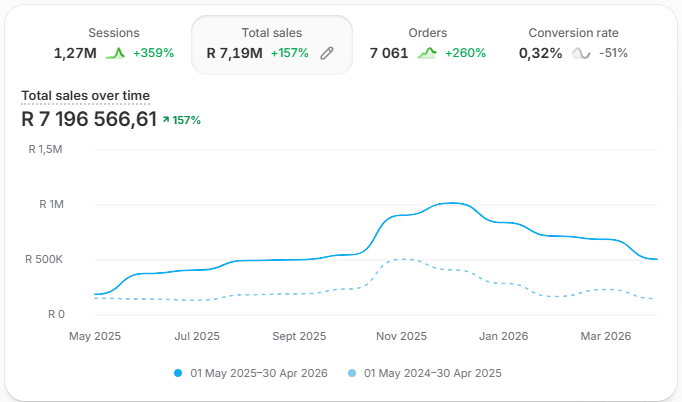
In the 12 months after we started scaling (May 2025 to April 2026) B2C revenue grew to R7.2M, up 157% on the prior year's R2.8M, a 2.6x increase. Orders climbed even faster, up 260%. Crucially, we achieved that while increasing ad spend by only around 45%, so revenue grew several times faster than the budget behind it.
A store that once could not clear R200k a month now regularly sees months in excess of R700k, with November pushing close to R1M around Black Friday. When the client runs promotions we help them scale hard into the demand, and the account keeps climbing.
Online Plant Nursery
Focus year: 2023 vs 2024 (full calendar years). We have worked with this client for roughly three years, from early on.
An online plant nursery selling a wide range of plants and greenery direct to consumers. We have worked with them for roughly three years, effectively from the beginning of their serious growth, which makes this one of our clearest long-term scaling stories.
This is less a turnaround story and more a scaling one. The business had genuine potential and a solid product, and our job was to build the engine that could grow it year after year without hitting a ceiling, then keep it profitable as it scaled.
The core is our scaling system, run across multiple platforms at once. Rather than pouring budget into a handful of ads, we produce a large and constant variety of paid media, static images, carousels, AI-generated video and user-generated content, then use tight segmentation to double down on the winning creatives and cut wasted spend on the losers. That mix is what lets us increase budget while keeping efficiency intact.
We also rebuilt the store itself. We moved them off WordPress onto Shopify with a completely new build, then ran conversion-rate optimisation on top: multiple payment gateways, product filtering, and a long list of user-experience refinements we have learned drive conversion over years of doing this. Better traffic and a better-converting store compounding together.
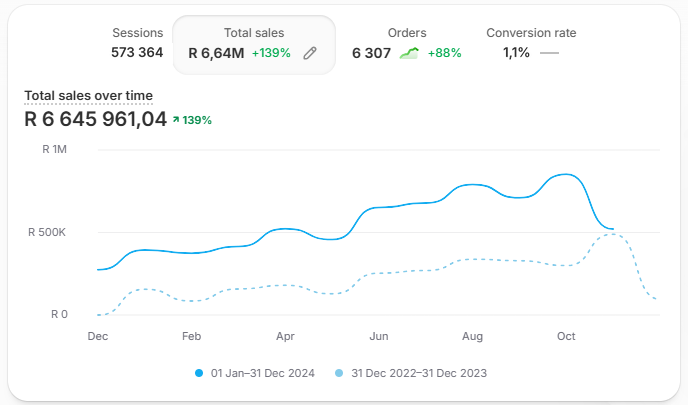
From 2023 to 2024 revenue grew from R2.8M to R6.6M, up 139%, a 2.4x increase, with orders climbing 88%. We did roughly double ad spend over that period, but revenue grew faster than the budget behind it, which is exactly what a healthy scaling system should do.
The business is now in a strong, stable position: consistently doing good numbers and highly profitable at its current spend. With the foundations, the creative engine and the store all working together, we simply keep scaling it year on year.
Footwear
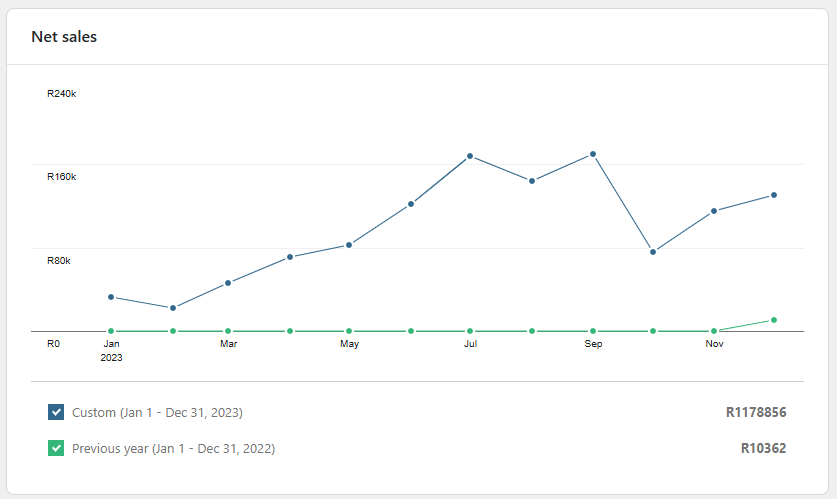
Comparing their first year trading largely on their own (Jan–Dec 2023) with the first full year after we took over (Jan–Dec 2024)
An online footwear retailer carrying a very large catalogue: multiple brands, with every style running across a full range of sizes. That is what makes the account complex, because every size of every shoe is its own stock position.
They launched properly in 2023 and made an acceptable start, finishing the year on R1.18M. But progress was slow and the growth curve was flat for long stretches. There was clearly a business there; it just was not being scaled.
We started on Google, where the buying intent was, and expanded into Meta once the foundations were producing. With a catalogue this size the real work was in the feed: we implemented an extensive set of feed rules to handle stock discrepancies, so that sizes which were out of stock stopped being advertised and budget stopped leaking on products nobody could actually buy. From there we segmented the account brand by brand rather than treating the catalogue as one block, and introduced email marketing to build and monetise a returning audience.
The bigger strategic move came later. The client told us that although turnover looked healthy, the profit was not where they wanted it, because the popular international brands they were known for carried thin margins. So we deliberately shifted the focus of the advertising away from those brands and onto their own in-house labels, which carry two to three times the margin. Harder products to sell, and less brand recognition pulling them along, which meant the creative and the targeting had to do considerably more of the work.
In our first full year the store went from R1.18M to R5.27M, a 347% increase and roughly 4.5 times the previous year. Monthly revenue moved from around R98K to R439K.
The more important outcome is what happened to profit. Having moved the product mix toward the in-house brands, they did not merely hold revenue while selling the harder, less famous products, they grew it further, and did so on products earning two to three times the margin. Several years in, the account is still climbing and the business is now genuinely profitable rather than simply busy.
Fragrance & Perfume
Comparing the final 5 months with their previous agency (Oct 2025–Feb 2026) with our first 5 months (Mar–Jul 2026)
An online fragrance retailer selling brand-name and imported perfumes.
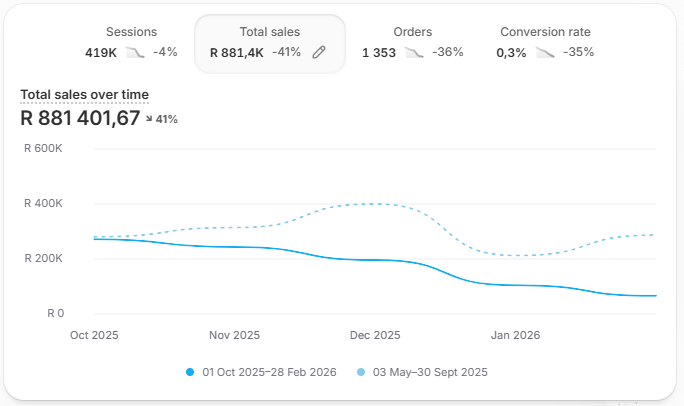
They came to us from a very well known South African agency, and the numbers were going the wrong way. In the five months before we started, the store did R881K and revenue was down 41% on the period before that. Orders were down 36%. They were spending steadily and getting no return on it.
Our audit found the causes quickly. There were serious stock limitations on the website that were quietly killing conversions, conversion tracking was not set up correctly, and the advertising itself was thin: static images only, with Google running nothing but a single Performance Max campaign.
We started with the store rather than the ads, because more traffic to a broken experience only wastes money. We ran conversion-rate optimisation across the site, advised the client directly on what stock levels they needed to hold, and implemented feed rules so that products which were out of stock stopped being advertised. Then we rebuilt conversion tracking properly, so every decision after that point was based on accurate data.
On creative, we moved them off static-only and into a proper mix of video, carousel and static. On Google, we broke the single Performance Max campaign into multiple asset groups, segmented every product inside Merchant Center, and introduced Search and Shopping campaigns, deliberately separating brand from prospecting search so we could finally see what was genuinely driving new customers rather than harvesting demand that already existed. Both accounts were completely restructured.
In our first five months the store did R3.43M, up 277%, having been in decline when we took over. Orders climbed 237% from 1,353 to 4,566, and the conversion rate more than doubled from 0.30% to 0.71%, which is the clearest sign the website and stock fixes did their job.
Ad spend went from roughly R40K to R70K per month, an increase of 75%, so revenue grew close to four times faster than the budget behind it. Monthly turnover now runs in the R700K to R1M+ range.
We will be straight about the start: the first month or two had teething problems we had to work through, as most rebuilds of this depth do. The account is now in a strong, stable position, the client is very happy, and we are moving into scaling it more aggressively.
You hired an agency, maybe two, maybe three, and every time it was the same story. Big promises in the sales call, radio silence after you signed. Months go by, budget disappears, and when you finally ask what's happening you get a PDF full of impressions and click-through rates that mean absolutely nothing to your bank account.
Campaigns with no structure. Audiences overlapping. No naming conventions. Pixel events firing incorrectly or not at all. You're spending money every day on a foundation that was never built properly, and every "optimisation" your last agency made just added another layer of mess on top.
Every month you get a report. It has graphs. It has numbers. It has a lot of green arrows pointing up. But you still can't answer the one question that matters: "Is this actually making me money?" The reporting is designed to make the agency look good, not to help you make decisions.
You signed up because of the senior strategist in the pitch meeting. Three weeks later, you're on calls with someone you've never met who clearly read your brief for the first time five minutes ago. Your account gets passed around like a hot potato, junior staff, rotating freelancers, whoever's available.
Your agency says they're "testing." What they really mean is they don't have a playbook and they're figuring it out on your dime. Every new creative is a guess. Every audience is a shot in the dark. You're not paying for expertise, you're funding their education.
You sell physical products to real consumers. But your agency runs your account the same way they run the local dentist's and the SaaS startup down the road. They don't understand product margins, seasonal buying behaviour, average order value, or customer lifetime value.
Revenue might be going up on paper, but your margins are shrinking. Ad costs are climbing, your cost per acquisition keeps creeping higher, and you're not sure if scaling is actually making you more profitable or just busier. Nobody's watching the numbers that matter.
Whether you've always handled your own ads or took them back after a bad agency experience, the result is the same. You're spending hours in Ads Manager instead of growing your business, second-guessing every decision, and knowing deep down that someone who does this full-time would get better results. You didn't build this business to be a media buyer, but right now, that's the job.
Most agencies operate like vending machines, you put money in, they push buttons, and you hope something comes out. They rotate junior staff through your account, copy-paste strategies from industries they don't understand, and send you dashboards full of vanity metrics that mean nothing to your bottom line. Omnia exists because we got tired of cleaning up their mess.
We're a specialist ecommerce performance team, every strategy, every ad account structure, every creative decision is built on consumer psychology and buying behaviour, not guesswork. We don't "test and learn" on your budget. We arrive with systems that already work.
You'll never wonder who's working on your account or what they're actually doing. You get a dedicated team of strategist, media buyer, and creative who know your brand, your margins, and your customers. We report on metrics that matter to business owners: revenue, ROAS, cost per acquisition, and profit. Not impressions. Not reach. Not "brand awareness."
Book your free 1-hour audit and get a clear plan for growth.
Book My Free Audit →We work exclusively with product brands and retailers selling online, not generalist marketing.
Attributed online sales generated for our clients. We deliver real revenue results for clients.
No work outsourced to third parties; we own every deliverable across our team of 15+ full-time employees.
You see exactly what is working and what is not, every month. We report bi-weekly, monthly, and quarterly on revenue and impact to your bottom line, not vanity metrics.
A real, in-house team of specialists: not freelancers, not outsourced, not rotating juniors.


In an industry full of lock-in contracts and hidden fees, here's how we do things differently.
In the first 7 days, we kick things off with an onboarding and a 90 day strategy presentation. If after that you are not happy with our direction or feel we are not delivering as promised, simply let us know and we will cancel immediately. No penalties, no questions asked.
Omnia is so confident in what we do that we do not charge any setup fees on ads. These fees typically run anywhere from R8,500 to R25,500 once-off, which we include for free.
Omnia has always offered month to month contracts. No long term commitments, we either make money together long-term or not at all. All SLA terms carry a 30 day cancellation notice.
Every account we work in is set up in your name and stays yours. We operate as a collaborator, never the account owner. If you ever leave, we assist with a clean handover and ensure you retain full access to everything. No holdbacks, no complications.
See why ecommerce brands trust Omnia to grow their revenue.
Book My Free Audit →We built Omnia for ecommerce brands that are done gambling on generalists.
| Omnia Digital | Generalist Agency | Freelancer / Contractor | DIY / In-House | |
|---|---|---|---|---|
| Ecommerce Specialisation | 100% ecommerce focus, every system built for product brands | Serves any industry, your account shares playbooks with dentists and lawyers | Varies, most are generalists picking up whatever work comes in | You know your product but not paid media at scale |
| Dedicated Team | Named strategist, media buyer, and creative assigned to your account | Rotating junior staff, whoever's available that week | One person doing everything, strategy, creative, reporting, invoicing | You, plus maybe a VA or junior hire with no paid media experience |
| Ad Account Setup | Audited and rebuilt properly, naming conventions, pixel events, campaign architecture | Inherited mess from the last agency, patched with band-aids | Set up once, rarely reviewed or restructured | Built from YouTube tutorials and guesswork |
| Reporting | Revenue, ROAS, CPA, contribution margin: numbers tied to profit | Impressions, reach, CTR: vanity metrics that hide poor performance | Sporadic updates, usually only when you chase them | You're staring at Ads Manager yourself |
| Creative Strategy | Built on buyer behaviour, product positioning, and conversion psychology | Template creative swapped across industries | Can execute briefs but rarely drives strategy | Limited, you're too close to see it like a customer |
| Accountability | Performance-driven, if it's not working, we tell you first and fix it | Blame the algorithm, the market, or your product | Disappears when results drop | No one to hold accountable but yourself |
| Speed to Results | Proven systems deployed, not starting from scratch on your budget | 3–6 month "learning phase" that may never end | Fast to start, slow to scale, hits a ceiling quickly | Months of trial and error |
| Platform Partnerships | Google, Meta, Shopify & Klaviyo Partner | May hold one or two, often lapsed | Rarely, partnerships require spend thresholds | Not applicable |
| Ecommerce Metrics | AOV, LTV, contribution margin, blended ROAS, we think like operators | Doesn't know your margin structure | Understands platform metrics but not business economics | You understand the business but struggle to connect it to ad performance |
Specialising in ecommerce has taught us exactly where we deliver the best results. Matching this criteria is essential for a successful partnership:
This isn't a 15-minute teaser call. It's a full diagnostic session where we pull up your website, your ad accounts, and your numbers, live, and show you exactly what's working, what's broken, and what to do about it.
We'll go through your website together and identify the conversion killers that are costing you sales right now: layout issues, friction in the checkout flow, missing trust signals, weak product pages, and the common ecommerce mistakes we see over and over. You'll get specific, actionable recommendations you can implement immediately, whether you work with us or not.
We'll screen-share and dive into your actual ad accounts: Meta, Google, email, whatever you're running. We'll look at campaign structure, audience targeting, creative performance, pixel setup, and attribution. Most accounts we audit have structural issues that are silently burning budget. We'll find them and show you exactly what needs to change.
We'll walk through your current ad spend, revenue, margins, cost per acquisition, and platform breakdown. This isn't to interrogate you, it's to understand whether paid media can be profitable for your business and at what scale. We'll also share what we see from our most successful ecommerce clients.
Based on everything we've reviewed, we'll map out what the next 90 days would look like: what to fix first, where to allocate budget, and what results you can realistically expect. You'll leave the call with a clear plan, not a vague "we'll get back to you."
Book your free 1-hour audit with Richard, Founder of Omnia Digital. No obligation. No hard sell. Just a clear plan.
Book My Free Audit →
We build your ads, content and product pages, all tailored to your e-commerce business, so more sales come in without spending more on ads
Actual Client Results
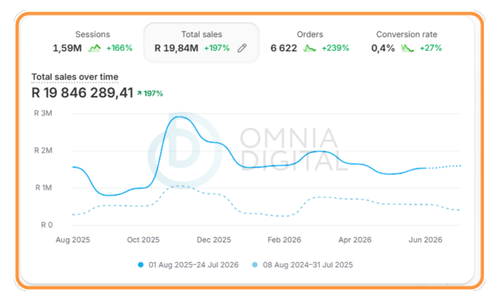
Every business below had a bad advertising foundation, was working with a generalist agency, running ads themselves, or had a bad ecommerce website.
Premium Fashion Retail
R4.9M → R13.3M
Online Revenue · May–Oct 2025 vs the 6 Months After
Fragrance & Perfume
−41% → +277%
Revenue · 5 Months Before vs 5 Months After
Online Plant Nursery
R2.8M → R6.6M
Revenue · +139% in One Year
Toys & Games
R2.8M → R7.2M
Online Revenue · +157% Year on Year
Footwear
R1.2M → R5.3M
Revenue · +347% Year on Year
Baby & Maternity
+35% Profit
Profitability Growth · Same Ad Budget
Premium Fashion Retail
Comparing the 6 months before partnering (May–Oct 2025) with the period after launch (Nov 2025–May 2026)
A premium fashion retailer with an established footprint of physical stores and a catalogue spanning a wide range of well-known brand-name labels. The brand itself was strong and the stores were performing, but the online side of the business had never reached the same level.
Marketing had been handled in-house, with a few agencies tried along the way. Results were up and down: moments of success, but never sustained. The team knew the store could do more. In the six months before partnering with us (May to October 2025), the online store did R4.9M in revenue.

Our audit found the reasons quickly: the conversion tracking foundations on both Meta and Google were incorrectly set up, campaign structure had almost no segmentation, a serious limitation for a store selling dozens of distinct brands, and the website itself had user-experience friction costing them conversions.
We started at the foundation and worked up. First, a conversion-rate pass on the website to fix the user-experience issues. Then a full rebuild of the conversion tracking across Meta and Google to the Omnia standard, so every decision from that point was based on accurate data.
From there we sat with the client to map out each brand in the catalogue: margins, stock position, what they wanted to push and what past data showed. That fed a full creative production run: AI-generated video and imagery, lifestyle shots, carousels and catalogue ads, all built for conversion. We launched brand-segmented campaigns across both Meta and Google, scaled Google hard, and layered in email marketing using the same brand segmentation with every flow rebuilt and tested.
Performance picked up from the day the new structure went live. From November 2025 to May 2026 the store did R13.3M, 141% up on the comparable prior period, with sessions up 168% and orders up 155%, all on effectively the same ad spend. Monthly revenue run rate climbed from roughly R820K to R1.9M.
The engagement has since shifted to pure scaling: monthly reporting and strategy sessions, stock-driven planning and clearance-sale support, and continual improvement brand by brand.
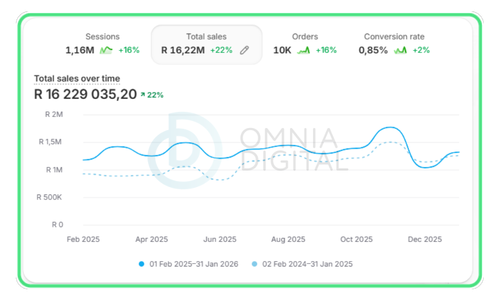
Baby & Maternity
Year 1 (flat ad spend, margin focus): +35% profit. Year 2 (TikTok added, +15% spend): scaled further. Compared against the final year with their previous agency.
A well-established online store in the baby and maternity space, selling a broad catalogue of products for expecting mothers, newborns and toddlers. The business had been trading for years and had a solid, loyal customer base by the time we started working together.
In the year before partnering with us (May 2023 to April 2024) the store was managed by another agency and did R12.9M in revenue. They had hit a ceiling. The previous agency could not scale the account any further, and although they kept adding budget, the extra spend only produced diminishing returns. Growth had stalled and more money was no longer the answer.
The strategy was also one-dimensional: chase top-line revenue, with little attention paid to which products were actually making money.
We started with the Omnia foundations: a full rebuild of conversion tracking and a large, ongoing content production run across image, video and carousel formats. But the strategic shift was where the real value came from.
In year one we deliberately kept ad spend constant and changed the focus from revenue to profit. Rather than pushing whatever sold easiest, we prioritised the higher-margin products, even the ones that were harder to sell, so that every rand of the same budget worked toward margin instead of just a bigger revenue number. The result was a 35% increase in profitability in our first year, without spending a cent more on ads.
A year in, with the foundations proven, we opened the taps: we introduced TikTok ads to reach a new audience and beat content fatigue with fresh formats, and increased ad spend by around 15% to scale the account further, this time with the creative breadth and horizontal structure to turn that budget into profitable growth rather than diminishing returns.
In our first year (May 2024 to April 2025) revenue grew to R14.5M, up roughly 15% on the prior year, on flat ad spend, while profitability jumped 35%. In year two (May 2025 to April 2026), with TikTok live and spend up around 15%, revenue climbed again to R16.8M and order volume rose 14%, taking total revenue growth to around 30% across the two years.
The headline is profitability: it has grown far faster than revenue and dramatically faster than ad spend. By breaking through the ceiling the previous agency could not, shifting the focus to margin, and scaling horizontally, we turned a stalled, mature store into one that grows its bottom line year on year.
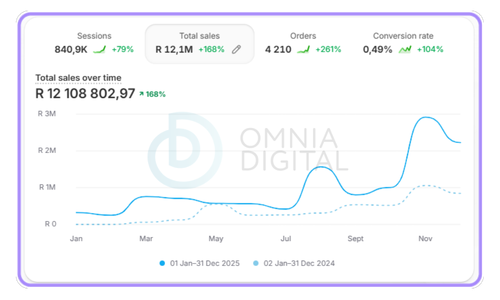
Toys & Games
B2C store revenue, comparing the 12 months before scaling with Omnia (May 2024–Apr 2025) against the 12 months after (May 2025–Apr 2026)
An online toy retailer with a wide catalogue spanning every kind of toy, plus a substantial B2B wholesale arm that we also manage. This case study focuses purely on the B2C side of the business: the direct-to-consumer online store.
Before working with us the store was small and struggling to break the R200k per month mark. They had seen varying levels of success over time but could never find a way to scale consistently. The growth ceiling was low and stubborn.
We took over the full paid strategy and built it around a combination of Meta and Google paid ads, supported by social media and email marketing. The biggest lever was granular product segmentation paired with Google's intent-based reach.
On Google we broke every product line out into its own asset group within Performance Max, and ran standard Shopping, Search, and PMax campaigns alongside each other, with dedicated focus on each of the main product lines. We mirrored that structure on Meta, with dedicated campaigns for every core product line and a deliberate push on top-of-funnel audiences to feed new customers into the store. This gave us tight control over budget and messaging at the product level rather than treating the catalogue as one blur.
In the 12 months after we started scaling (May 2025 to April 2026) B2C revenue grew to R7.2M, up 157% on the prior year's R2.8M, a 2.6x increase. Orders climbed even faster, up 260%. Crucially, we achieved that while increasing ad spend by only around 45%, so revenue grew several times faster than the budget behind it.
A store that once could not clear R200k a month now regularly sees months in excess of R700k, with November pushing close to R1M around Black Friday. When the client runs promotions we help them scale hard into the demand, and the account keeps climbing.
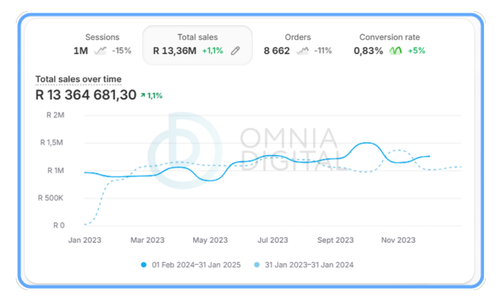
Online Plant Nursery
Focus year: 2023 vs 2024 (full calendar years). We have worked with this client for roughly three years, from early on.
An online plant nursery selling a wide range of plants and greenery direct to consumers. We have worked with them for roughly three years, effectively from the beginning of their serious growth, which makes this one of our clearest long-term scaling stories.
This is less a turnaround story and more a scaling one. The business had genuine potential and a solid product, and our job was to build the engine that could grow it year after year without hitting a ceiling, then keep it profitable as it scaled.
The core is our scaling system, run across multiple platforms at once. Rather than pouring budget into a handful of ads, we produce a large and constant variety of paid media, static images, carousels, AI-generated video and user-generated content, then use tight segmentation to double down on the winning creatives and cut wasted spend on the losers. That mix is what lets us increase budget while keeping efficiency intact.
We also rebuilt the store itself. We moved them off WordPress onto Shopify with a completely new build, then ran conversion-rate optimisation on top: multiple payment gateways, product filtering, and a long list of user-experience refinements we have learned drive conversion over years of doing this. Better traffic and a better-converting store compounding together.
From 2023 to 2024 revenue grew from R2.8M to R6.6M, up 139%, a 2.4x increase, with orders climbing 88%. We did roughly double ad spend over that period, but revenue grew faster than the budget behind it, which is exactly what a healthy scaling system should do.
The business is now in a strong, stable position: consistently doing good numbers and highly profitable at its current spend. With the foundations, the creative engine and the store all working together, we simply keep scaling it year on year.
Footwear
Comparing their first year trading largely on their own (Jan–Dec 2023) with the first full year after we took over (Jan–Dec 2024)
An online footwear retailer carrying a very large catalogue: multiple brands, with every style running across a full range of sizes. That is what makes the account complex, because every size of every shoe is its own stock position.
They launched properly in 2023 and made an acceptable start, finishing the year on R1.18M. But progress was slow and the growth curve was flat for long stretches. There was clearly a business there; it just was not being scaled.
We started on Google, where the buying intent was, and expanded into Meta once the foundations were producing. With a catalogue this size the real work was in the feed: we implemented an extensive set of feed rules to handle stock discrepancies, so that sizes which were out of stock stopped being advertised and budget stopped leaking on products nobody could actually buy. From there we segmented the account brand by brand rather than treating the catalogue as one block, and introduced email marketing to build and monetise a returning audience.
The bigger strategic move came later. The client told us that although turnover looked healthy, the profit was not where they wanted it, because the popular international brands they were known for carried thin margins. So we deliberately shifted the focus of the advertising away from those brands and onto their own in-house labels, which carry two to three times the margin. Harder products to sell, and less brand recognition pulling them along, which meant the creative and the targeting had to do considerably more of the work.
In our first full year the store went from R1.18M to R5.27M, a 347% increase and roughly 4.5 times the previous year. Monthly revenue moved from around R98K to R439K.
The more important outcome is what happened to profit. Having moved the product mix toward the in-house brands, they did not merely hold revenue while selling the harder, less famous products, they grew it further, and did so on products earning two to three times the margin. Several years in, the account is still climbing and the business is now genuinely profitable rather than simply busy.
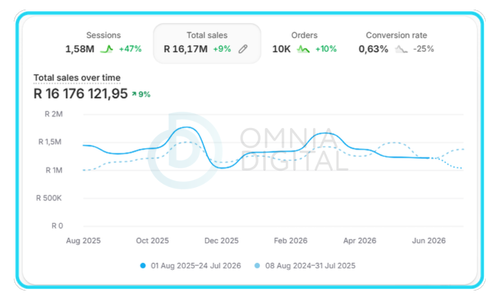
Fragrance & Perfume
Comparing the final 5 months with their previous agency (Oct 2025–Feb 2026) with our first 5 months (Mar–Jul 2026)
An online fragrance retailer selling brand-name and imported perfumes.
They came to us from a very well known South African agency, and the numbers were going the wrong way. In the five months before we started, the store did R881K and revenue was down 41% on the period before that. Orders were down 36%. They were spending steadily and getting no return on it.
Our audit found the causes quickly. There were serious stock limitations on the website that were quietly killing conversions, conversion tracking was not set up correctly, and the advertising itself was thin: static images only, with Google running nothing but a single Performance Max campaign.
We started with the store rather than the ads, because more traffic to a broken experience only wastes money. We ran conversion-rate optimisation across the site, advised the client directly on what stock levels they needed to hold, and implemented feed rules so that products which were out of stock stopped being advertised. Then we rebuilt conversion tracking properly, so every decision after that point was based on accurate data.
On creative, we moved them off static-only and into a proper mix of video, carousel and static. On Google, we broke the single Performance Max campaign into multiple asset groups, segmented every product inside Merchant Center, and introduced Search and Shopping campaigns, deliberately separating brand from prospecting search so we could finally see what was genuinely driving new customers rather than harvesting demand that already existed. Both accounts were completely restructured.
In our first five months the store did R3.43M, up 277%, having been in decline when we took over. Orders climbed 237% from 1,353 to 4,566, and the conversion rate more than doubled from 0.30% to 0.71%, which is the clearest sign the website and stock fixes did their job.
Ad spend went from roughly R40K to R70K per month, an increase of 75%, so revenue grew close to four times faster than the budget behind it. Monthly turnover now runs in the R700K to R1M+ range.
We will be straight about the start: the first month or two had teething problems we had to work through, as most rebuilds of this depth do. The account is now in a strong, stable position, the client is very happy, and we are moving into scaling it more aggressively.
You hired an agency, maybe two, maybe three, and every time it was the same story. Big promises in the sales call, radio silence after you signed. Months go by, budget disappears, and when you finally ask what's happening you get a PDF full of impressions and click-through rates that mean absolutely nothing to your bank account.
Campaigns with no structure. Audiences overlapping. No naming conventions. Pixel events firing incorrectly or not at all. You're spending money every day on a foundation that was never built properly, and every "optimisation" your last agency made just added another layer of mess on top.
Every month you get a report. It has graphs. It has numbers. It has a lot of green arrows pointing up. But you still can't answer the one question that matters: "Is this actually making me money?" The reporting is designed to make the agency look good, not to help you make decisions.
You signed up because of the senior strategist in the pitch meeting. Three weeks later, you're on calls with someone you've never met who clearly read your brief for the first time five minutes ago. Your account gets passed around like a hot potato, junior staff, rotating freelancers, whoever's available.
Your agency says they're "testing." What they really mean is they don't have a playbook and they're figuring it out on your dime. Every new creative is a guess. Every audience is a shot in the dark. You're not paying for expertise, you're funding their education.
You sell physical products to real consumers. But your agency runs your account the same way they run the local dentist's and the SaaS startup down the road. They don't understand product margins, seasonal buying behaviour, average order value, or customer lifetime value.
Revenue might be going up on paper, but your margins are shrinking. Ad costs are climbing, your cost per acquisition keeps creeping higher, and you're not sure if scaling is actually making you more profitable or just busier. Nobody's watching the numbers that matter.
Whether you've always handled your own ads or took them back after a bad agency experience, the result is the same. You're spending hours in Ads Manager instead of growing your business, second-guessing every decision, and knowing deep down that someone who does this full-time would get better results. You didn't build this business to be a media buyer, but right now, that's the job.
Most agencies operate like vending machines, you put money in, they push buttons, and you hope something comes out. They rotate junior staff through your account, copy-paste strategies from industries they don't understand, and send you dashboards full of vanity metrics that mean nothing to your bottom line. Omnia exists because we got tired of cleaning up their mess.
We're a specialist ecommerce performance team, every strategy, every ad account structure, every creative decision is built on consumer psychology and buying behaviour, not guesswork. We don't "test and learn" on your budget. We arrive with systems that already work.
You'll never wonder who's working on your account or what they're actually doing. You get a dedicated team of strategist, media buyer, and creative who know your brand, your margins, and your customers. We report on metrics that matter to business owners: revenue, ROAS, cost per acquisition, and profit. Not impressions. Not reach. Not "brand awareness."
Book your free 1-hour audit and get a clear plan for growth.
Book My Free Audit →We work exclusively with product brands and retailers selling online, not generalist marketing.
Attributed online sales generated for our clients. We deliver real revenue results for clients.
No work outsourced to third parties; we own every deliverable across our team of 15+ full-time employees.
You see exactly what is working and what is not, every month. We report bi-weekly, monthly, and quarterly on revenue and impact to your bottom line, not vanity metrics.
A real, in-house team of specialists: not freelancers, not outsourced, not rotating juniors.


In an industry full of lock-in contracts and hidden fees, here's how we do things differently.
In the first 7 days, we kick things off with an onboarding and a 90 day strategy presentation. If after that you are not happy with our direction or feel we are not delivering as promised, simply let us know and we will cancel immediately. No penalties, no questions asked.
Omnia is so confident in what we do that we do not charge any setup fees on ads. These fees typically run anywhere from R8,500 to R25,500 once-off, which we include for free.
Omnia has always offered month to month contracts. No long term commitments, we either make money together long-term or not at all. All SLA terms carry a 30 day cancellation notice.
Every account we work in is set up in your name and stays yours. We operate as a collaborator, never the account owner. If you ever leave, we assist with a clean handover and ensure you retain full access to everything. No holdbacks, no complications.
See why ecommerce brands trust Omnia to grow their revenue.
Book My Free Audit →We built Omnia for ecommerce brands that are done gambling on generalists.
| Omnia Digital | Generalist Agency | Freelancer / Contractor | DIY / In-House | |
|---|---|---|---|---|
| Ecommerce Specialisation | 100% ecommerce focus, every system built for product brands | Serves any industry, your account shares playbooks with dentists and lawyers | Varies, most are generalists picking up whatever work comes in | You know your product but not paid media at scale |
| Dedicated Team | Named strategist, media buyer, and creative assigned to your account | Rotating junior staff, whoever's available that week | One person doing everything, strategy, creative, reporting, invoicing | You, plus maybe a VA or junior hire with no paid media experience |
| Ad Account Setup | Audited and rebuilt properly, naming conventions, pixel events, campaign architecture | Inherited mess from the last agency, patched with band-aids | Set up once, rarely reviewed or restructured | Built from YouTube tutorials and guesswork |
| Reporting | Revenue, ROAS, CPA, contribution margin: numbers tied to profit | Impressions, reach, CTR: vanity metrics that hide poor performance | Sporadic updates, usually only when you chase them | You're staring at Ads Manager yourself |
| Creative Strategy | Built on buyer behaviour, product positioning, and conversion psychology | Template creative swapped across industries | Can execute briefs but rarely drives strategy | Limited, you're too close to see it like a customer |
| Accountability | Performance-driven, if it's not working, we tell you first and fix it | Blame the algorithm, the market, or your product | Disappears when results drop | No one to hold accountable but yourself |
| Speed to Results | Proven systems deployed, not starting from scratch on your budget | 3–6 month "learning phase" that may never end | Fast to start, slow to scale, hits a ceiling quickly | Months of trial and error |

| Platform Partnerships | Google, Meta, Shopify & Klaviyo Partner | May hold one or two, often lapsed | Rarely, partnerships require spend thresholds | Not applicable |
| Ecommerce Metrics | AOV, LTV, contribution margin, blended ROAS, we think like operators | Doesn't know your margin structure | Understands platform metrics but not business economics | You understand the business but struggle to connect it to ad performance |
Specialising in ecommerce has taught us exactly where we deliver the best results. Matching this criteria is essential for a successful partnership:
This isn't a 15-minute teaser call. It's a full diagnostic session where we pull up your website, your ad accounts, and your numbers, live, and show you exactly what's working, what's broken, and what to do about it.
We'll go through your website together and identify the conversion killers that are costing you sales right now: layout issues, friction in the checkout flow, missing trust signals, weak product pages, and the common ecommerce mistakes we see over and over. You'll get specific, actionable recommendations you can implement immediately, whether you work with us or not.
We'll screen-share and dive into your actual ad accounts: Meta, Google, email, whatever you're running. We'll look at campaign structure, audience targeting, creative performance, pixel setup, and attribution. Most accounts we audit have structural issues that are silently burning budget. We'll find them and show you exactly what needs to change.
We'll walk through your current ad spend, revenue, margins, cost per acquisition, and platform breakdown. This isn't to interrogate you, it's to understand whether paid media can be profitable for your business and at what scale. We'll also share what we see from our most successful ecommerce clients.
Based on everything we've reviewed, we'll map out what the next 90 days would look like: what to fix first, where to allocate budget, and what results you can realistically expect. You'll leave the call with a clear plan, not a vague "we'll get back to you."
Book your free 1-hour audit with Richard, Founder of Omnia Digital. No obligation. No hard sell. Just a clear plan.
Book My Free Audit →
Your details are only used to prepare and book your audit call.